
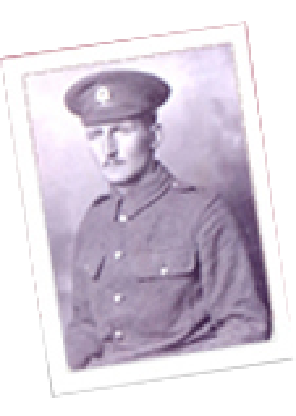
- First Name(s):ArthurCyril
- Surname:WHITE
- Service Number:111523
- Rank:
Pilot Officer/Observer
- Conflict:WW2
- Service:Air Force
- Air Force:Royal Air Force Volunteer Reserve
- Former Units:None
- Date of Death:31st May 1942
- Age At Death:23
- Place of Death:Unknown
- Place of Burial:Uden War Cemetery, Netherlands, Grave 4. A. 6.
- Place of Birth:Unknown
- Home Town:Unknown
- Casualty's Relatives:
Son of the Venerable Arthur White, M.A., and Elizabeth White, of Orrell, Lancashire

WHITE Arthur Cyril Is Named On These Memorials
Further Information About WHITE Arthur Cyril
Arthur White was born on 27th August 1917. He entered Form Rem, Kings School in January 1932 as a King’s scholar under School House. At the time of his admission to the school his parent is recorded as Rev. A.W., Golborne Rectory Warrington. Arthur had previously been educated at Arnold House (Prep), Llanddulas, Denbigh. He left Kings School from Cbl(?) 6 in July 1937. Remarks: Keble College, Oxford.
School records courtesy of Kings School Archives.
The following information has been researched by and is courtesy of Theon Minten:
Arthur White was the Observer on Wellington-bomber DV740, EU-0 of 26 OTU Squadron R.A.F. The aircraft crashed between Alem and Kerkdriel, ± 200 metres, near the Dode Maas in the Alemsche Overwaard.
On Saturday, 30 May 1942, a number of aircraft of the 26 OTU squadron (RAF), took off for a mission to Koln in Germany from a station (airfield) in or near Graveley. One of the crew members was Pilot Officer A C White. He departed for his mission at 23:05.
He flew with a Vickers Wellington (type IC, with serial DV740 and code EU-O). His mission and of the other crew members was planned for Sunday, 31 May 1942.
The aircraft was shot down by Oblt Horst Patuschka of 4./NJG2 flying a Messerschmidt BF110 during the first 1000 bomber raid on Cologne.
Crew members also killed in action: D.H. Fletcher, H.L. Smith and D.S.B. Vincent.
The crew were buried on the 2nd June 1942 in the priests’ garden next to the St Petrus church in Uden, grave 23. They were reburied in the autumn of 1946 at Uden War Cemetery, 4.A.6.
POW: Sergeant Freddie Hillyer
Freddie Hillyer died suddenly on March 6th 1993. Amongst his possessions his family found a photo of his crew. He had kept the photo without anyone knowing about it.
M Middlebrook M., The Bomber Command War Diaries
30/31 May 1942
THE THOUSAND-BOMBER RAID, COLOGNE
1,047 aircraft were dispatched, this number being made up as follows:
1 Group – 156 Wellingtons
3 Group – 134 Wellingtons, 88 Stirlings = 222 aircraft
4 Group – 131 Halifaxes, 9 Wellingtons, 7 Whitleys = 147 aircraft
5 Group – 73 Lancasters, 46 Manchesters, 34 Hampdens = 153 aircraft
91 (O.T.U.) Group – 236 Wellingtons, 21 Whitleys = 257 aircraft
92 (O.T.U.) Group – 63 Wellingtons, 45 Hampdens = 108 aircraft
Flying Training Command – 4 Wellingtons
Aircraft totals: 602 Wellingtons, 131 Halifaxes, 88 Stirlings, 79 Hampdens, 73 Lancasters, 46 Manchesters, 28 Whitleys = 1,047 aircraft
The exact number of aircraft claiming to have bombed Cologne is in doubt; the Official History says ‘898 aircraft bombed’ but Bomber Command’s Night Bombing Sheets indicate that 868 aircraft bombed the main target with 15 aircraft bombing other targets. The total tonnage of bombs was 1,455, two-thirds of this tonnage being incendiaries.
German records* show that 2,500 separate fires were started, of which the local fire brigade classed 1,700 as ‘large’ but there was no ‘sea of fire’ as had been experienced at Lübeck and Rostock because Cologne was mainly a modern city with wide streets. The local records contained an impressive list of property damaged: 3,330 buildings destroyed, 2,090 seriously damaged and 7,420 lightly damaged. More than 90 per cent of this damage was caused by fire rather than high-explosive bombs. Among the above total of 12,840 buildings were 2,560 industrial and commercial buildings, though many of these were small ones. However, 36 large firms suffered complete loss of production, 70 suffered 50-80 per cent loss and 222 up to 50 per cent. Among the buildings classed as totally destroyed were: 7 official administration buildings, 14 public buildings, 7 banks, 9 hospitals, 17 churches, 16 schools, 4 university buildings, 10 postal and railway buildings, 10 buildings of historic interest, 2 newspaper offices, 4 hotels, 2 cinemas and 6 department stores. Damage was also caused to 17 water mains, 5 gas mains, 32 main-electricity cables and 12 main-telephone routes. The only military installation mentioned is a Flak barracks. In domestic housing, the following ‘dwelling units’ (mainly flats/apartments) are listed: 13,010 destroyed, 6,360 seriously damaged, 22,270 lightly damaged. These details of physical damage in Cologne are a good example of the results of area bombing. Similar results can be expected in those of Bomber Command’s raids which were successful during following years.
The estimates of casualties in Cologne are, unusually, quite precise. Figures quoted for deaths vary only between 469 and 486. The 469 figure comprises 411 civilians and 58 military casualties, mostly members of Flak units. This death toll was a new record for an R.A.F. raid. 5,027 people were listed as injured and 45,132 as bombed out. It was estimated that from 135,000 to 150,000 of Cologne’s population of nearly 700,000 people fled the city after the raid.
The R.A.F. casualties were also a record high figure. 41 aircraft were lost, including 1 Wellington which was known to have crashed into the sea. The 41 lost aircraft were: 29 Wellingtons, 4 Manchesters, 3 Halifaxes, 2 Stirlings, 1 Hampden, 1 Lancaster, 1 Whitley. The total loss of aircraft exceeded the previous highest loss of 37 aircraft on the night of 7/8 November 1941 when a large force was sent out in bad weather conditions, but the proportion of the force lost in the Cologne raid – 3.9 per cent – though high, was deemed acceptable in view of the perfect weather conditions which not only led to the bombing success but also helped the German defences.
Bomber Command later estimated that 22 aircraft were lost over or near Cologne -16 shot down by Flak, 4 by night fighters and 2 in a collision; most of the other losses were due to night-fighter action in the radar boxes between the coast and Cologne. Bomber Command also calculated the losses suffered by each of the three waves of the attack – 48, 4.1 and 1.9 per cent – and assumed that the German defences were progressively overwhelmed by bombing and affected by smoke as the raid went on. Further calculations showed that the losses suffered by the operational training unit crews – 3.3 per cent – were lower than the 4.1 per cent casualties of the regular bomber groups and also that those training aircraft with pupil pilots suffered lower casualties than those with instructor pilots!
Another Victoria Cross was awarded for an action on this night. A Manchester of 50 Squadron, piloted by Flying Officer L. T. Manser, was caught in a searchlight cone and seriously damaged by Flak on the approaches to Cologne. Manser held the plane steady until his bomb load was released and, despite further damage, set course for England although he and his crew could have safely bailed out after leaving the target area. But the Manchester steadily lost height and, when it became obvious that there was no hope of reaching England, Manser ordered his crew to bail out, which they all did safely. In holding the plane steady for the last man to leave, Manser lost the opportunity to save himself and was killed. He is buried at Heverlee War Cemetery in Belgium.
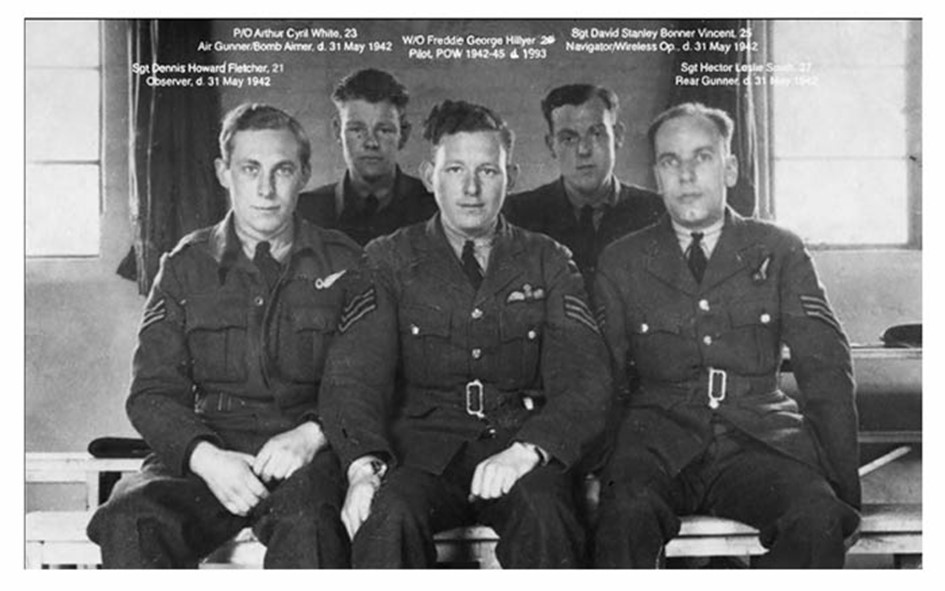
Crew of Wellington DV740
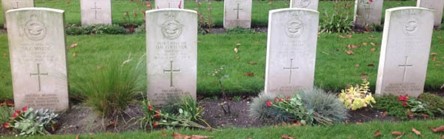 Graves of 4 of the crew
If you have any information about WHITE Arthur Cyril, please get in touch
Information AboutWHITE Arthur Cyril