
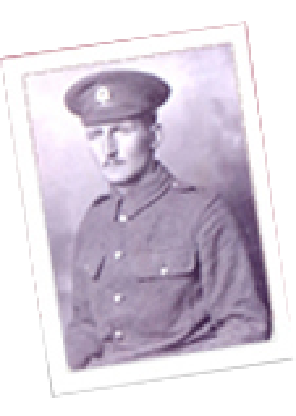
- First Name(s):JamesBentley
- Surname:WAGSTAFF
- Service Number:240727
- Rank:
Private
- Conflict:WW1
- Service:Army
- Army Sector:Infantry
- Regiment:Worcestershire Regiment
- Battalion:8th Battalion
- Former Units:None
- Date of Death:24th April 1917
- Age At Death:
- Place of Death:Unknown
- Place of Burial:Unicorn Cemetery, Vend'Huile, France, Special Memorial B. 2.
- Place of Birth:Unknown
- Home Town:Unknown
- Casualty's Relatives:Unknown

WAGSTAFF James Bentley Is Named On These Memorials
Notes About The Memorial(s) Listed Above
Worcester Cathedral Cloister Windows Kings School, surname spelt Wagstaffe.
Wyre Piddle War Memorial, surname spelt Wagstaff.
Fladbury St John the Baptist Church under Wyre casualties with the information: 1917, surname spelt Wagstaffe.
Further Information About WAGSTAFF James Bentley
Private, Worcester Regt.
Born, October 30, 1881. Fell in action in France, August, 1917.
J. B. Wagstaff was the only son of Mr. J. W. B. Wagstaff, of Wyre, Pershore. He entered the School House under Mr. Bolland in September, 1895, in the Lower School. As a small boy he suffered from much physical weakness, but this he steadily outgrew and before he left won the School High Jump in 1901. He entered a firm of engineers at Birmingham, and had to surrender good prospects when the call for service came. He was of a quiet and affectionate disposition, with little taste for fighting, but he bravely did his duty and gave his life for his country in the push of August last.
W. H. C
Source for additional information: The Vigornian, November 1917, No.90, Vol.VIII
The Vigornian, March 1918, No.91, Vol. XI.:
Bentley Wagstaffe, whose death was presumed in our last issue, was officially reported missing on April 24, 1917, after the fight of Guillemont Farm, in which the Worcesters were heavily engaged. His company was surrounded and only 17 got away safe. It is still hoped by his friends that he may be a prisoner. His father was the late J. W. B. Wagstaff, of Wyre, Pershore.
W. H. C.)
Kidderminster Times 23rd June 1917:
Private James Bentley Wagstaffe, 240727, 1st/8th Battalion Worcestershire Regiment. Son of the late Mr Francis Wagstaffe and Mrs Wagstaffe, Wyre, Pershore. Has been missing since 24th April.
The following information is courtesy and copyright of Robert Wagstaff:
James Bentley (known as Bene to family and friends) Wagstaffe was born in 1881 and lived at Wyre near Pershore, Worcestershire. He was part of a large family, all sisters with the exception of Bene (7 children, some died very young). His father, Bentley Wagstaffe, was a solicitor. His mother was Eliza (nee Williams). He attended Worcester Kings School. He was unmarried when he was killed in the First World War at the age of 35, but he had a girlfriend, Madeline Goddard and I believe they intended to get married. He seems to have been a kind, rather gentle person, certainly well loved by his family and well liked by his friends and comrades. My father felt that he had little real experience of the world and was in no way, what we would now call, street wise. He had no job unto the time he enlisted.
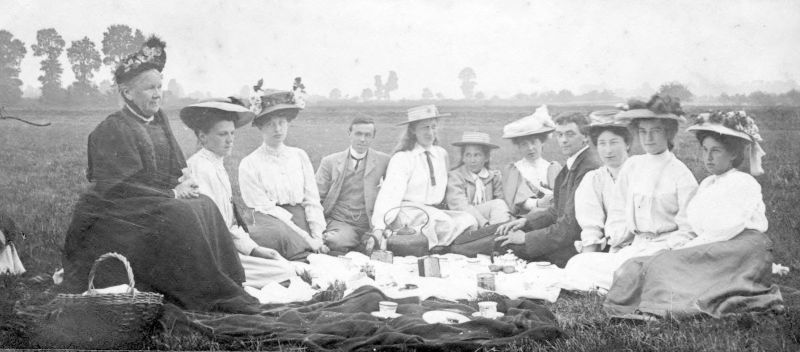
Bentley Wagstaff with family, Bene is 4th from the left.
Photo courtesy & copyright of Robert Wagstaff
He enlisted in 1914 in the Worcestershire Regiment as a Private. He is said to have had a difficult basic training period and was picked on by a Sergeant who already knew him. Perhaps he was picked on because he was from a quite well to do family and not a very “manly” character.
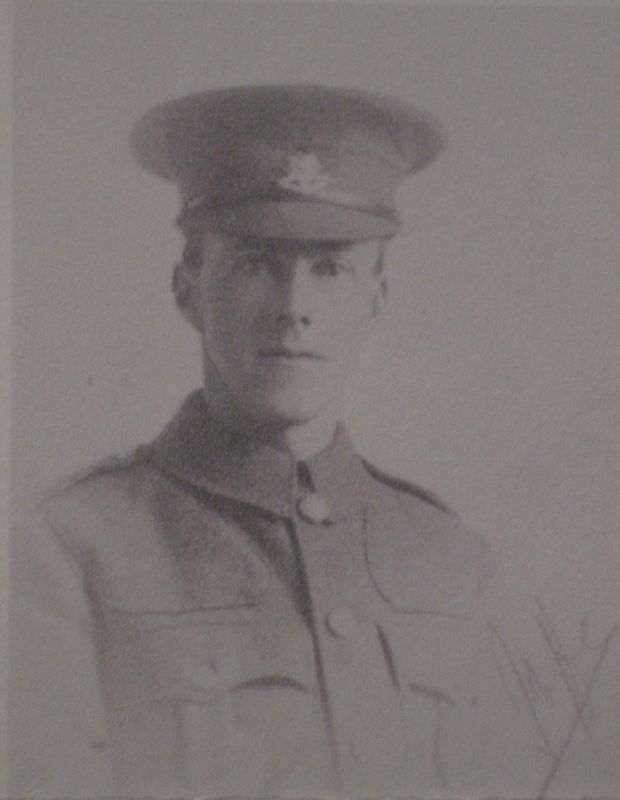
Bentley Wagstaff in uniform.
Photo courtesy & copyright of Robert Wagstaff
Bene was reported killed on 24th April 1917 in the battle of Guillemont farm near Templeux Le Guerard, one of the many useless battles that achieved nothing but lead to great loss of life. His body was never identified and there is a mystery about where he did actually die. One of his comrades, a man named Colley, reported that Bene was hit and was seen to fall as Colley, his brothers and Bene and others started for the first objective. Colley stopped briefly to speak to the fallen Bene but got no reply and so he just had to go on. Colley was later wounded in the leg but managed to hobble back using his rifle as a crutch. On the way back he looked for Bene and his own brothers but did not see them, finding out later that he had not retraced his steps exactly.
As Bene’s body was not identified it was assumed that he was missing believed killed on or just after 24th April. Tha family made enquiries through the Red Cross and various other agencies in the hope that the wounded Bene had been taken prisoner but no trace of him was found.
The War Graves Commission erected a memorial to Bene in Unicorn Cemetery (not the cemetery near Guillemont Farm) which says “Believed to be buried in this cemetery”.
In 1920 the family received a letter from a headmaster in Germany which stated that his son, now also dead, had found a letter from Bene to the family in the pocket of a dead British soldier who had been killed in an action near Arras in May 1917. I do not have this letter but I know that it meant a great deal to the family to receive his last letter as I have a letter from Alice Wagstaffe to the German headmaster thanking him for taking the time to send Bene’s letter.
This was a month after Bene was said to have died and some 45 miles from Guillemont Farm. As can be imagined this came as a great shock to the family who now did not know what to believe.
I think that Bene’s death had a very profound effect on the family. Emily, the last sister to die, left Wyre in the 1950s to go to live in Clevedon. I think she went to live with her friend Miss D.T. Terry at Goodreste, The Avenue. She was said to be a charming person but had a severe look about her. She was musical and it is said that Elgar used to cycle from Worcester to give her violin lessons. The family are all buried in Wyre churchyard, the house where they lived is just opposite the church. Emily was cremated at Canford in Bristol on 10th November 1961.
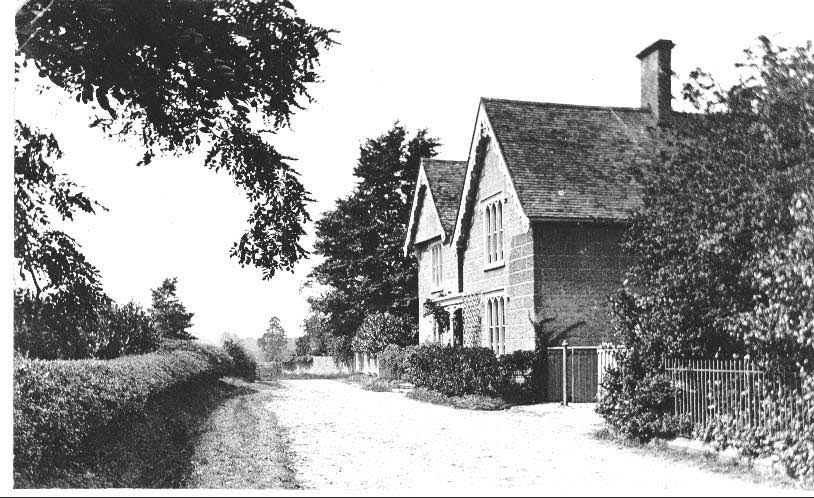
The home of the Wagstaff family.
Photo courtesy & copyright of Robert Wagstaff
Some memories of Frank Maury Goddard:
I am prompted by my family to record some of my boyhood memories of the Wagstaff’s of Wyre House for they were old friends of my parents, and my brothers and my sister Madeline spent much time in their company. I, the youngest member of my family by far, from the age of 5 years or so was also included in many associations with Wyre House from about 1911 onwards.
What I have written therefore are only the memories – often very vivid – of a little boy more than seventy years ago, reflecting a way of way of life long gone, and shattered after two World Wars.
It came about that at that time my sister Madeline became engaged to be married to the Wagstaff’s son and heir James Bentley Wagstaff, generally known as Bene, and I recall that both families, the Wagstaff’s and my own were very pleased at the prospect of further consolidating a valued friendship.
But many happy days and years were to end suddenly by the tragic death of Bene in the great War of 1914 – 1918, for at a very early date he had joined the colours, and rapidly was drafted to France where he was killed somewhere near Arras; the sad circumstances of his death I shall refer to later.
Some years were to elapse before Madeline really recovered from the shock of Bene’s death, and it was not until soon after the Great War had ended that she met and fell in love with a young ex-naval surgeon, Broke Heywood-Waddington, who had served in H.M.S. Ramillies, and who was the nephew of old friends of ours in Pershore, and later married him.
My memory of Bene was that he was dark, tall, spare and clean shaven and with dark brown eyes. I do not think he was particularly handsome, but as a child, I realised that he had many fine qualities. For he was very kind and always considerate and he had a very gentle nature.
Bene had no hesitation in volunteering at the earliest possible moment, in spite of the apprehension of his sisters who adored him and a somewhat tearful Madeline.
In no way was gentle, kind Bene cut out for soldiering and the awful trench warfare of those days. He underwent a brief and almost savage training in the ranks at Norton, and he was particularly unlucky in his company commander. The latter was the son of a retired colonial Bishop, an old friend of the Wagstaff’s, and he seemed to relish ‘taking it out’ on Bene for some unknown reason.
I remember one day there was a route march from Norton Barracks to Pershore, where a short rest was made in the Broad Street near my home. Bene, pretty well exhausted after a seven-mile march, obtained permission to see us for a few moments, before the return march to Norton. This was the last occasion I saw him and I think it must have been the last time Madeline and my parents saw him, for very soon he was posted to France.
Bene was killed in action as I mentioned earlier, somewhere near Arras, but for many years there was confusion as to where he actually fell and the attendant circumstances of his death. I believe that these uncertainties were never satisfactorily resolved, and that even the inscription on his war grave stone casts doubts on the positive identification of the body beneath.
If you have any information about WAGSTAFF James Bentley, please get in touch
Information AboutWAGSTAFF James Bentley
Credits: Kidderminster Times researched and transcribed by Adrian Carter.