
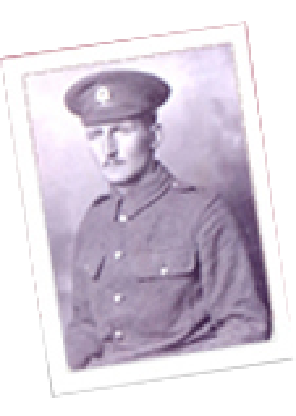
- First Name(s):KennethLawrence
- Surname:COLLINS
- Service Number:5117681
- Rank:
Private
- Conflict:WW2
- Service:Army
- Army Sector:Infantry
- Regiment:Somerset Light Infantry
- Battalion:7th Battalion
- Former Units:None
- Date of Death:20th November 1944
- Age At Death:22
- Place of Death:Unknown
- Place of Burial:Leopoldsburg War Cemetery, Belgium, Grave VI. B. 14.
- Place of Birth:Unknown
- Home Town:Unknown
- Casualty's Relatives:Unknown

COLLINS Kenneth Lawrence Is Named On These Memorials
Notes About The Memorial(s) Listed Above
Listed on the memorial as Patrick Collins.
Further Information About COLLINS Kenneth Lawrence
Appears on the Army casualties list for Worcestershire.
Appears on the list of WW2 casualties for the Bromsgrove District.
Information provided by family members of this casualty provide the information that the mix up in names occurred when, as a young boy, Kenneth was nicknamed Pat after the well known Fair Showman Pat Collins and was thereafter always known as Pat.
Kenneth Collins enlisted in the army on 31st May 1940 in Worcester. He was just 18 years of age having celebrated his birthday on 18th May. He was given the rank of Private, service no 5117681 and was posted to the 11th Home Defence Battalion, The Royal Warwickshire Regiment at Aston Barracks, Witton, Birmingham. At the time of his attestation Kenneth was 5ft 4½ inches tall with a fresh complexion, fair hair and grey eyes. His next of kin is given as his grandfather, Thomas Hughes Senior of Wychbold.
Kenneth’s service records reveal that he was sent with his battalion to Wittering in Lincolnshire in July 1940. On 19th September 1940 he was transferred from the Royal Warwickshire Regiment to the 70th battalion South Staffordshire Regiment and by 31st November 1940 he was in Saltburn-on-Sea, Northumberland. Here he remained until the summer of 1942 during which time he was granted several periods of leave. From Saltburn he was posted first to Northallerton and then transferred to the 7th battalion South Staffordshire Regiment and posted to Grimsby in Lincolnshire. Over the next two years, Kenneth remained in England, moving south in order to participate in the follow up of the D-Day landings in June 1944. Kenneth is believed to have sailed from Newhaven on 24th June 1944, landing in France 2 days later at or near Graye-sur-Mer. Once ashore the battalion moved inland towards Bayeux and Creully.
An extract from the history of the South Staffordshire Regiment reads:
“In effect, the 8th August 1944 was the end for the 7th South Staffords. Casualties in the Normandy campaign were outstripping the number of reinforcements available and it was decided that the 59th Division would be split up for no other reason than that it was the junior unit. It was no reflection on its fighting qualities, it had fought well, but at the same time it had sustained a high casualty rate. A number of the survivors of the 7th South Stafford’s were transferred to the 6th North Stafford’s for a short while to make the unit up to strength before Major Roberts was to take a composite company from the remnants of 7th South Staffords, which was to fight as a complete sub unit with the 7th Battalion, Somerset Light Infantry. He himself was to be awarded the Military Cross and a Mention in Despatches before the end of the war. The Somerset Light Infantry had lost a complete company, which had been captured.”
Kenneth’s service records reveal that for a very short period of time he was indeed part of the 6th Battalion North Staffordshire Regiment before being transferred to the 7th Battalion Somerset Light Infantry in August 1944. The regimental diary reveals that the battalion saw action at Nijmegen Bridge on September 21st with Oosterhaut following a day later and Elst, opposite Arnhem, the day after that. Randwijk and Zetten followed on 26th-27th September while the next dates mentioned cover the period October 9th to November 10th when the unit saw action in the vicinity of Groesbeek, Mook and De Horst.
The next phase of fighting commenced on 18th November 1944 after the battalion had moved South and crossed the border into Germany. The 7th Battalion’s first objective was to be the village of Neiderheide, just to the north of the town of Geilenkirchen, the latter being an American force objective. Other units were to secure the nearby villages of Tripsrath, Hochheid, Hoven and Bauchem.
The next day, Hochheid Woods were attacked. Slightly more confused in its inception, this attack was laid on at great speed. Unfortunately, though the eventual aims were completed, the ground conditions and continuous rain took great toll, particularly on the ability to use any form of mechanical transport with which to support the infantry. Enemy fire was also a major problem and casualty numbers were considered to be severe. Nevertheless, this attack succeeded. However, somewhere in the vicinity of Hochheid village, Kenneth Collins received the shrapnel wounds that were to prove fatal. He died of wounds at Hochheid on 20th November 1944.
Additional information courtesy and copyright of Kenneth’s family.
The following information is courtesy and copyright of Dave Hughes:
Postscript to the preceding story
The following came about as the result of my attending a talk at Deddington, the fairly local village where I sing in the church choir. Deddington is what I term quite an active village – many things take place there so from time-to-time I involve myself in one way or another, often singing in concerts, for example.
Anyway, as it was the period of Remembrance, and the local Royal British Legion Branch were organising a couple of talks, I decided to attend. I was particularly interested in the second of the talks, this relating to The Commonwealth War Graves Commission (CWGC) and its work throughout the world, the talk given by a Mr Dick Richards. The connection I felt was due to the visit I made with Grandsons Jonah and Dante in 2017 when we followed in Kenneth’s footsteps from the D-Day beaches to his ultimate demise in that lovely little village in Germany, though not so lovely when he was there, of course. During that journey, we visited quite a few of the CWGC cemeteries, not least the one in Leopoldsburg, Belgium, where Kenneth is buried.
Anyway, the talk was so very interesting, the speaker being so enthusiastic and knowledgeable; he had quite obviously undertaken considerable research concerning his chosen subject and was able to impart this to those present, not least me. But it set me thinking – was it possible he might add to the story, Kenneth’s story, our story, in ways I hadn’t imagined. Was it possible he might advise me of things I didn’t already know, for instance, why is Kenneth buried so far from where he fell? Further, as we now have a photo of Kenneth’s grave with a cross at the head, rather than the Portland Stone headstone that we found when we visited, how did this all come about?
Well, it would seem that Leopoldsburg is not the first place Kenneth was buried. This does not really surprise me because Leopoldsburg is so far from Hochheid, where he lost his life. The first burial location was right on the Dutch/Belgian border at a place called Eisden, written as Eysden on the copy of what is known as the “Graves Concentration Report Form”. Being so close to the border between the two countries, on the border in fact, Eisden is given as being in both countries depending upon what map or reference you look at. Also, being part of the Flemish areas of the two countries, I have come across versions of the village name which have the letter “J” inserted though I cannot remember whereabouts so I’ve left it out. I was advised that like many who were buried close to the front where they fell their bodies were subsequently exhumed and the graves ‘concentrated’ into larger cemeteries (hence the Concentration Report Form).
Though I have been advised that it is possible I might be able to find out when he was first buried, I haven’t yet followed that up. In fact, I’m not sure I will be able to because I may need authorised access to the CWGC site and I don’t have that. But I will spend a while looking just in case.
The form mentioned above tells me precisely when Kenneth was reburied in Leopoldsburg Cemetery, the date being 19th August 1946, a year and 8 months after his demise. That suggests the earlier burial was not one of a temporary nature, possibly that Eisden was planned to be a permanent cemetery. Again, reasons for the change of plan are not known. The form clearly tells us he was buried alongside a former colleague in the 7th Battalion Somerset Light Infantry, he being Acting Corporal W Allen. Again I am advised that where it was known soldiers were from the same unit, the CWGC ensured that they remained comrades in death as in war. I particularly like that idea.
I enquired about the photo depicting the wooden cross and was advised that where practicable, the CWGC would have forwarded copies to relatives. This explains why we have photos of both The Leopoldsburg Cross, as it was described to me, and of the later Portland Stone memorial. I had always wondered where the latter photo had come from as I could not imagine any of the family actually travelling to Leopoldsburg to take such a photo. The answer is clear now, they didn’t, the photo was supplied to each family by CWGC as part of their commitment to the fallen soldiers and their families. I have included three photos taken during June 1948 and they all depict a cemetery where each grave has a cross at its head. Two subsequent photos, taken in April 1950, show the partial replacement of crosses with Portland Stone headstones. Later still, in September 1951, the photos show a cemetery where all crosses have been replaced with Portland Stone headstones. This suggested to my contact that the formal replacement of the crosses began in about 1950 (to quote him).
Though I didn’t think about it, and it certainly didn’t occur to me to ask, my contact also commented that there was no epitaph at the base of the Portland Stone headstone, beneath the cross. Such an epitaph, which might have been, for example, “Lest we Forget”, “Rest in Peace”, or similar, related to the faith of the deceased and so could have been Jewish or any other faith and would have been confirmed at the behest of the family. My contact was quick to point out that there is no epitaph at the base of Kenneth’s headstone so it would seem the family chose not to have one. I struggle with this slightly on a personal level but when I realise that it would have been my paternal Grandfather, Thomas Edward Hughes, who would have had to make such a decision, perhaps that explains things. I could be wrong, of course, but Grandfather Hughes was not the easiest of persons from the little I learned of him.
All this postscript information is included in the sense that who knows, one day others might visit the areas of France, Belgium, Holland and Germany that we visited and take in the places we visited. One day, all this might be of relevance in assisting others. Whatever, I have enjoyed telling this addition to the story, particularly where it embellishes our respective histories. There now follows the photo of the 1946 cross, the Grave Concentration Report form and the collection of photos mentioned in the preceding:
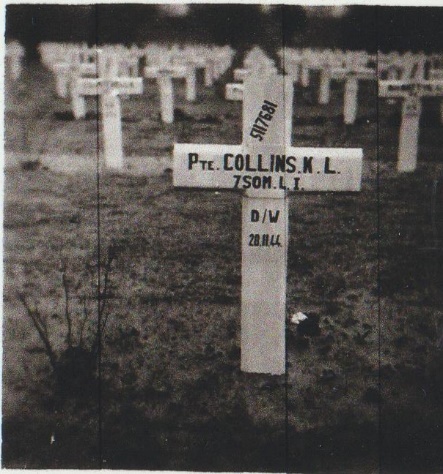
It was suggested to me that this photo might have been taken in 1946, soon after the reburial simply because the ground surrounding the Cross is less “tended” than in subsequent photos, the plants between crosses not yet established. This might then equate to the CWGC sending photos of the recently installed cross to each family per the foregoing text.
I then decided I would “brevit” amongst the details in the CWGC website to see what else it might add to the info I had already gleaned. Though I came to the conclusion “not much” there were a couple of documents I found which I believe have added to the overall picture of how events unfolded.
The first was headed “Graves Registration Report Form”. Most information within it was already known. However, I believe the document clarifies when the Leopoldsburg Cemetery was finally completed, ie, when the last of the Crosses were finally exchanged for Portland Stone headstones. At top right, you will see that Plot VI, Row B, was “Certified Complete and Correct” on 27 January 1954. I reckon it was most probably completed before that date as the 1951 photo suggests, but 1954 is most probably the date it appears to have been formally signed-off.
The second was just headed “Schedule A”. This document appears to clarify those families who must have requested an epitaph be added beneath the headstone cross as opposed to those that didn’t. You will see that Kenneth, third down in the left-hand column, had no epitaph added. He was not alone amongst those listed on this sheet, five had epitaphs, including Cpl Allen, Kenneth’s comrade-in-arms, five didn’t. But then, take a moment to look at the ages of those listed – 18, 19, two aged 20, 21 – all younger than Kenneth at 22. Yes, four were older at 27, 28, 31 and 35 but even they were relatively young men.
I leave you with the thought, “Lest we forget?”.
The following report appears in the Bromsgrove Weekly Messenger Saturday 6th January 1945:
WYCHBOLD SOLDIER’S DEATH FROM WOUNDS Pte. K.L. Collins
Pte. Kenneth Lawrence Collins (22), Somerset Light Infantry, who lived with his grandfather, Mr T. Hughes, Stoke Prior Terrace, Wychbold, died of wounds sustained in the fighting in Holland. Pte. Collins was employed by Mr S.T. Gittins, Wychbold, when he volunteered for the Army in 1940. He was educated at Rashwood School. His death has been notified to Mr H.L. Wilton, Chairman of the British Legion, who give help in all such cases.
In the following week’s newspaper under local casualties there is a very small piece stating: Pte. K.L. Collins (22) Somerset Light Infantry, of Wychbold, who, as reported last week, died of wounds in Holland. The report contains a photograph of Kenneth Collins.
If you have any information about COLLINS Kenneth Lawrence, please get in touch
Information AboutCOLLINS Kenneth Lawrence
Credits: Bromsgrove Weekly Messenger researched and transcribed by Sandra Taylor.