
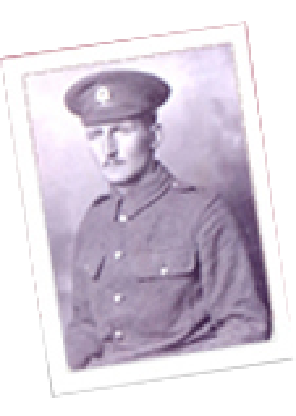
- First Name(s):JohnDaniel
- Surname:GRIFFITHS
- Service Number:27903
- Rank:
Private
- Conflict:WW1
- Service:Army
- Army Sector:Infantry
- Regiment:Worcestershire Regiment
- Battalion:3rd Battalion
- Former Units:None
- Date of Death:23rd August 1916
- Age At Death:22
- Cause of Death:Killed in action
- Place of Death:Unknown
- Place of Burial:Commemorated on Thiepval Memorial, France, Pier and Face 5A and 6C.
- Place of Birth:Codsall, Staffordshire, enlisted Hollywood, Birmingham, resident Birmingham
- Home Town:Unknown
- Casualty's Relatives:
Son of Mrs. Griffiths, of Bewdley, Worcestershire, and the late Daniel Griffiths; husband of Polly Griffiths, of The Chestnuts, Alcester Rd., Wythall, Alvechurch, Birmingham
An Image Of this Grave Is Available To Order
Order Grave's Image

GRIFFITHS John Daniel Is Named On These Memorials
Notes About The Memorial(s) Listed Above
Bewdley War Memorial as John Dan. Griffiths with the information: Pte. Wor. R.
Wythall War Memorial as Daniel Griffiths.
Wythall St Mary’s Church as Daniel Griffiss.
Wythall Kingswood Meeting House as Daniel Griffis.
Further Information About GRIFFITHS John Daniel
Appears on the Commonwealth War Graves Commission and Soldiers Died in the Great War as Daniel Griffiths. The birth of John Daniel Griffiths is registered in the March Quarter 1895 under the Wolverhampton Registration District.
The 25th Division had relieved the 29th Division in the line immediately west of the River Ancre. The 3rd Worcestershire went into the trenches on 31st July, relieving the 10th Battalion Cheshire Regiment, and held the line until 6th August. It was a fairly quiet time in spite of heavy fighting across the river. (Casualties of the Battalion during this period totalled 33: 8 killed, 25 wounded). The 25th Division was relieved by the 6th Division, and on 6th August the 3rd Worcestershire were relieved by the 1st West Yorkshire. The Battalion marched back into billets at Bertrancourt and remained there until the 11th August, resting and making friendswith the Guards Division close by. Among other acts of courtesy, the Irish Guards sent their drums to play at a guest-night held on 8th August to celebrate the promotion of Lt.-Col. W.B. Gibbs, who had been appointed to command, in succession to Colonel Davidge. The 25th Division moved right back for training and the 7th Brigade marched first to Sarton, where on 12th August the Brigade was inspected by H.M. the King, and then on 15th August by Marieux southward to the training area at Puchevillers.
On 17th August the training was completed, and the 7th Brigade moved Eastward to the line, marching through Harponville to Hedauville. Early on the following day the 3rd Worcestershire and the 1st Wiltshire moved forward once more into the “Leipzig Salient” in front of Thiepval.
At Thiepval itself the position had altered but little since the beginning of July; but the 48th Division, further to the right, had gained most of the Ovilliers spur and it had been decided that the time had come to commence a systematic attack against the fortress. During the next forty-eight hours (19th – 21st August) no great move was made, although local fighting was continuous. (Note: Casualties 3rd Worcestershire Regiment on 19th August were 1 killed, 1 wounded, on 21St August 1 officer (2/Lt. Kilby) and 10 men wounded, on 22nd August 2 killed, 1 officer (2/Lt. F.A.M. Hedges) and 7 men wounded). However, plans were being made, and early on 21st August orders were issued for a combined attack by the 25th and 48th Divisions.
The Leipzig Salient (Battle of Pozieres Ridge) Second Phase. The 23rd August and the morning of 24th August passed without notable incident – on 23rd August the 3rd Worcestershire casualties were 1 officer wounded (2/Lt J.C. Talbot), 7 killed, 49 wounded. The sun blazed down while final arrangements were completed for the attack on the enemy’s position in front: a strongly fortified line known as the “Lemberg Trench”. At 4.10pm, the British artillery suddenly opened a devastating barrage fire, and the Worcestershire and Wiltshire climbed out of their trenches and advanced. Covered by the barrage, the two battalions closed up to the enemy’s line; then, as the guns lifted their fire, they dashed in with bomb and bayonet. The enemy made a stout resistance and there was much desperate fighting. At one point a German machine-gun detachment tried to get their gun up to the parapet, to enfilade the trench. Lance-Corporal W Shenton, the leader of a Lewis-gun section, quickly hoisted his Lewis-gun onto a traverse. It was a matter of seconds between them, but the British weapon just got into action first. The German machine-gunners were shot down and their machine-gun was captured. Lance Corporal Shenton was awarded the Distinguished Conduct Medal for this action.
A fierce bombing fight followed up and down the trench. From both flanks the enemy bombers came pressing inwards to retake their lost ground; but the Worcestershire bombers held them back. Small bombing parties headed by 2/Lieut. W.S. Knowles and 2/Lieut G.P. O’Donovan fought desperately on the flanks of the captured trench until the enemy’s effort died away and the gain was secure. The Battalion captured 2 machine-guns and 80 prisoners and 2/Lieuts Knowles and O’Donovan were awarded the Military Cross.
Then, under a storm of heavy shells, all ranks set to work to entrench and consolidate the captured trenches. The enemy were too disorganised to attempt any immediate counter-attack and during the night the entrenchment was satisfactory completed. Major G.S. Briscoe showed great courage in leading carrying parties forward across the open and in directing the work under heavy fire until he was hit. Major Briscoe was awarded the Distinguished Service Order.
In spite of fierce bombardment, much gallant work was done by the signallers of the Battalion. Sergeant F.D. Jowett maintained communication between the captured trench and the previous line for over five hours. He was wounded, but stubbornly refused to leave his work until he was hit again and disabled. Sergeant Jowett was awarded the Distinguished Conduct Medal.
During 25th August the enemy’s guns bombarded the captured position. The bombardment was most trying to men exhausted by twelve hours of battle; but the troops stood it gamely, cheered on by the example of their young officers. Second Lieutenants H. King and S.P.J. McDonald were conspicuous by their bravery, exposing themselves freely and keeping up the spirits of their men during the worst of the 4 hour bombardment. Both were awarded the Military Cross. Second Lieutenant J.B. Barron, although wounded before the attack started, refused to leave the line and continued to direct the consolidation until the position was secured. He was awarded a bar to his Military Cross. Any target afforded in the enemy’s trench was at once dealt with by bursts of fire. A counter-attack was expected, and arrangements to meet it were perfected.
At 5.30pm the enemy’s guns broke forth with a terrific fire, and the glint of crowded bayonets in the trenches opposite told of the impending assault, but the British Artillery was ready; and a barrage even fiercer than their own was loosed upon the German trenches. Peering from our front line amid the crashing shells, the soldiers of the 3rd Worcestershire waited for the German attack; but no attack came. It was impossible for anything human to live in the open, and the enemy’s trench beyond was being pounded to pieces. Gradually the shelling died down, and at dusk (7.30pm) a daring patrol crept forward from the trenches of the Worcestershire and made their way from shell-hole, across to the opposite line. They found the German trench smashed and broken, filled along its whole length with killed and wounded. But amid their stricken comrades a remnant of the enemy were still holding on, still waiting with fixed bayonets for the order to attack. They were the 5th Grenadier Regiment of the Prussian Guard.
No further counter-attack was attempted, the fighting died down, and on the evening of 26th August the two victorious battalions were relieved. Three days of battle had cost the 3rd Worcestershire a total loss of 234 men including nine officers.
The Battalion was relieved by the 8th Border Regiment, and marched back to billets in Hedauville; whence on 28th August a move was made to Bouzincourt.
3rd Worcestershire Casualties:- 24th – 26th August: Killed – 2/Lieut W.L. Perks. Wounded – Major G.S. Briscoe, Captain K.L. Spiers, Captain J.B. Barron, Lieut E.L. Lazarus, 2/Lieut W.S. Knowles, 2/Lieut J.C. Tull, 2/Lieut J. Kilby, 2/Lieut F.J.H. Hedges.
Rank and file 24th August – killed 24, wounded 123. missing 11.
25th August – killed 9, wounded 37, missing 1.
26th August – killed 4, wounded 13, missing 3.
Total:- killed 37, wounded 173, missing 15.
Source for additional information: The Worcestershire Regiment in the Great War by Captain H. FitzM. Stacke of the Regiment, 1928.
A photograph of Private J.D. Griffiths of Bewdley can be found in Berrow’s Worcester Journal Supplement, Saturday 21st October 1916, available at Worcestershire Archives.
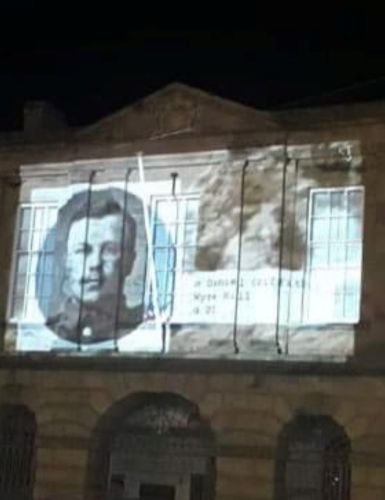
Daniel Griffiths, projected on Bewdley Town Hall in 2018
Photograph courtesy & copyright of great grandson Matt Finch
John Griffiths has no known grave, the photograph available shows his name on Thiepval Memorial as D. Griffiths.
If you have any information about GRIFFITHS John Daniel, please get in touch
Information AboutGRIFFITHS John Daniel
Credits: Additional information researched and transcribed by Simon Fielding.